90-Day Marketing Roadmap
Prioritize the highest-impact marketing actions for the next quarter — and execute with confidence.
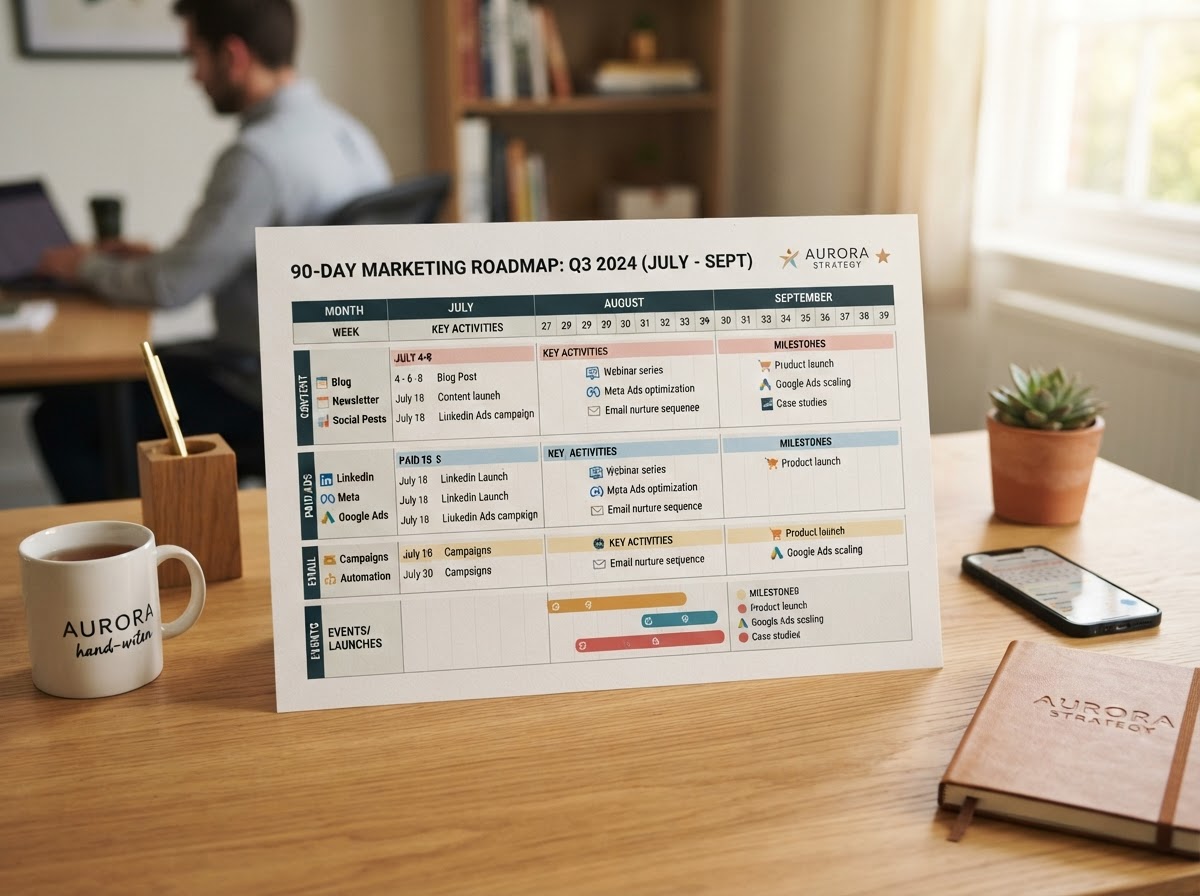
Most marketing plans fail not because the strategy is wrong, but because there's no clear sequence of what to do first, second, and third. This 90-day roadmap template gives you a prioritized, week-by-week action plan so your team always knows what to work on and why it matters.
What's Inside
- A week-by-week 90-day action plan template you can customize
- Priority scoring framework to decide what to do first
- Channel-specific task checklists for SEO, paid media, content, and CRM
- Goal-setting worksheet tied to revenue targets
- Weekly review and reporting cadence template
- Resource allocation guide for teams of any size
Why 90 Days?
90 days is the sweet spot for marketing planning. It's long enough to see compounding results from content and SEO, but short enough to course-correct before you waste budget. Most importantly, it forces prioritization — you can't do everything, so you have to choose the things that move the needle most.
This template breaks the quarter into three 30-day phases: Foundation, Acceleration, and Optimization. Each phase has clear deliverables, owners, and success metrics.
Phase 1: Foundation (Days 1–30)
Week 1: Audit current performance — analytics, SEO, paid media, conversion rates. Set baseline KPIs and revenue targets.
Week 2: Define or refine target audience, value proposition, and messaging. Document the buyer journey and identify gaps.
Week 3: Set up or clean up tracking — GA4 events, conversion tracking, UTM convention, CRM pipeline stages. You can't optimize what you can't measure.
Week 4: Build the quick-win campaign — refresh the highest-traffic landing page, launch a retargeting campaign, or fix the top 3 technical SEO issues.
Phase 2: Acceleration (Days 31–60)
Week 5–6: Launch or scale paid media campaigns on the top 1–2 channels. Implement A/B testing on landing pages and ad creative.
Week 7: Publish cornerstone content — the 2–3 pieces most likely to rank and drive organic traffic. Optimize for AEO with FAQ schema.
Week 8: Build automation workflows — lead routing, nurture sequences, and follow-up reminders. Speed-to-lead is one of the highest-impact levers.
Phase 3: Optimization (Days 61–90)
Week 9–10: Analyze results. Double down on top-performing channels and campaigns. Pause or restructure underperformers.
Week 11: Expand content production based on what's driving traffic and leads. Layer in AI tools for drafting, optimization, and reporting.
Week 12: Review the full quarter. Document wins, losses, and learnings. Build the next 90-day plan with updated priorities.
The Priority Scoring Framework
Not sure what to do first? Score every potential initiative on three factors: Impact (how much will this move revenue?), Effort (how many hours/dollars will this take?), and Confidence (how sure are we this will work?). Multiply Impact × Confidence, then divide by Effort. The highest scores go to the top of the queue.
This simple formula prevents the most common planning mistake: spending weeks on high-effort, low-confidence projects while ignoring the quick wins sitting right in front of you.
Key Takeaways
- 90-day plans force prioritization and create accountability
- Start with foundation (tracking, messaging, quick wins) before scaling spend
- Speed-to-lead automation is one of the highest-ROI activities in Phase 2
- Use Impact × Confidence ÷ Effort to prioritize initiatives
- End each quarter with a review and the next quarter's plan ready
Who This Is For
Marketing managers, founders, and fractional CMOs who need a structured plan they can hand to a team and execute — without spending weeks building it from scratch.
Download the TEMPLATE
Fill out the form to get instant access.
Ready to Put This Into Action?
Get a custom growth audit tailored to your business. Our senior strategists will identify your highest-impact opportunities.